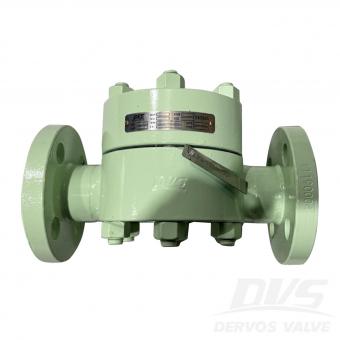
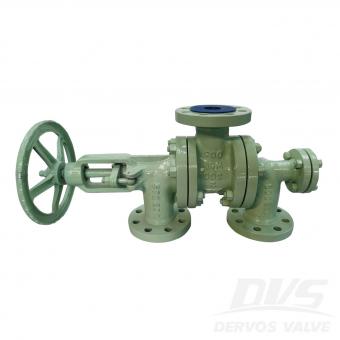
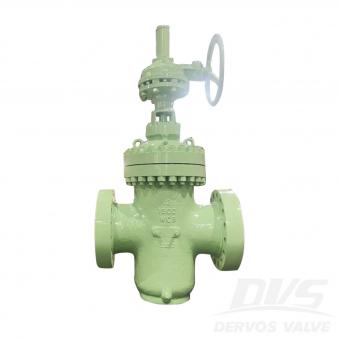
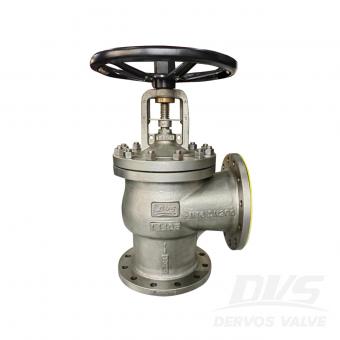
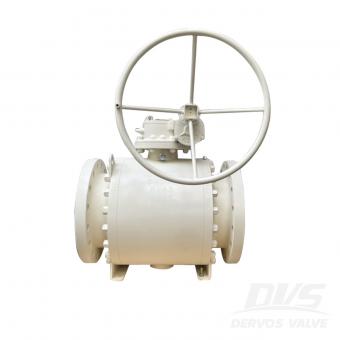
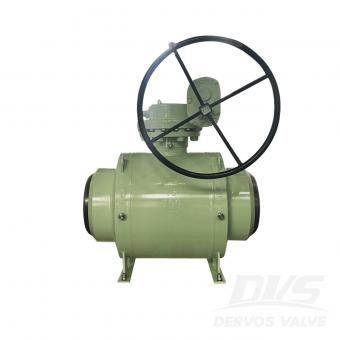
For a conventional ASTM A216 WCB valve built to common ASME/API practice, treat -29°C (-20°F) as the normal lower screening limit unless the applicable piping code and documented impact qualification support something colder. ASTM A216 is a casting material specification for elevated-temperature service; it does not, by itself, certify a complete valve for low-temperature duty.
The number on a catalogue is therefore only the beginning. The project must establish the valve's minimum design metal temperature (MDMT), then verify every pressure-retaining part and temperature-sensitive component against it.
WCB is widely used for carbon-steel valve bodies and bonnets. A typical product range may state -29°C to about 425°C, with pressure-temperature ratings governed by the valve design standard. That range does not mean every WCB casting has demonstrated toughness at -29°C, and it does not authorise operation below that temperature.
ASTM A216 controls chemistry, heat treatment, tensile properties and casting quality. Routine Charpy V-notch impact testing at a low temperature is not the defining requirement that it is for ASTM A352 low-temperature castings. A hydrostatic shell test also proves pressure containment at the test condition, not resistance to brittle fracture at the project's MDMT.
If the design temperature is below -29°C, the clean procurement route is usually to specify a low-temperature material rather than ask a standard WCB valve to cross an unverified boundary. A project engineer may approve another code-compliant route, but it must be supported by the governing code, material condition, section thickness and impact-test records, not a general statement that carbon steel “can handle it.”
Normal fluid temperature is not always the lowest temperature the valve will see. Rapid depressurisation, gas expansion, flashing, blowdown, start-up, winter standby or a cold stream entering a warm line can reduce the body temperature below the normal operating value. Ambient temperature may govern an outdoor valve that remains pressurised but stagnant.
The datasheet should state both the minimum operating temperature and the MDMT, including credible transient conditions. If a gas valve normally operates at 5°C but can cool to -38°C during depressurisation, selecting WCB from the normal temperature misses the controlling case.
ASTM A352 is written for pressure-containing castings intended primarily for low-temperature service. Its usual minimum impact-test temperature is -46°C (-50°F) for both LCB and LCC. That is an impact qualification temperature for the material, not an automatic guarantee that every assembled valve may be used at -46°C.
|
Material grade |
ASTM specification |
Common low-temperature reference |
Practical meaning |
|
WCB |
ASTM A216 |
-29°C (-20°F) screening limit |
Standard carbon-steel casting; verify any colder duty separately |
|
ASTM A352 |
-46°C (-50°F) impact-test temperature |
Low-temperature casting with mandatory impact requirements |
|
|
LCC |
ASTM A352 |
-46°C (-50°F) impact-test temperature |
Same test temperature as LCB, with higher strength and impact acceptance |
LCC is not automatically suitable for a lower temperature than LCB. Under ASTM A352, LCC has higher minimum tensile and yield strength and slightly higher impact-energy acceptance, but both grades use the same usual test temperature. Selection between them should follow the valve design, pressure class, wall section, availability and project material specification.
Below -46°C, simply writing “LCC” is not enough. Colder ASTM A352 grades such as LC1, LC2 or LC3, or an appropriate austenitic stainless or nickel-alloy construction, may be required. The choice depends on temperature, pressure, media, corrosion, valve type and the governing code.
The body and bonnet should have compatible low-temperature qualification, but the review must continue through the bolting, stem, closure member, seat rings, springs, packing, gaskets and actuator accessories. Elastomers and thermoplastics can harden or lose sealing capability before the metal reaches its limit. Low-temperature bolting and qualified weld procedures may also be required.
For cast pressure parts, request material certificates that identify the heat number, grade, heat treatment and actual Charpy test temperature and results. Review repair-weld records where applicable. Confirm that the markings and certificates belong to the delivered body and bonnet rather than to a generic sample heat.
The RFQ should state the design code and edition, pressure class, minimum and maximum design temperature, fluid, phase, depressurisation case, required leakage performance, body and bonnet materials, bolting, trim, seat and seal materials, impact-test requirements, NDE, testing and document package. If the supplier quotes only “WCB,” “LCB” or “LCC,” the low-temperature boundary is still undefined.
The useful decision rule is straightforward: use WCB only where the verified MDMT remains within its accepted project range; move to a fully specified LCB/LCC valve for typical service down to -46°C; and start a separate material and valve-design review below -46°C. The lowest body-material number must never be mistaken for the rating of the complete valve assembly.


Авторское право © 2015-2026 DERVOS VALVE CO.,LTD.Все права защищены Блог / Карта сайта / XML / политика конфиденциальности