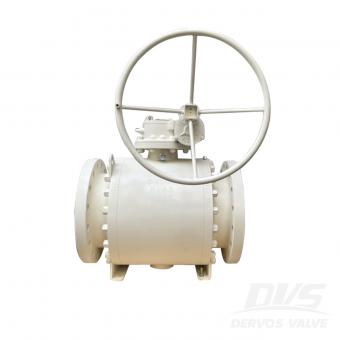
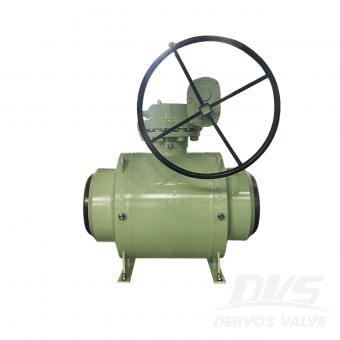
A wafer ball valve usually fits a tight piping layout better because its body is shorter and lighter than a conventional flanged ball valve. This saves axial space, but the shorter valve may still be difficult to use if there is little room for through-bolts, flange separation, the handle or the actuator. Compare the complete installation and maintenance envelope, not face-to-face length alone.
A wafer ball valve is clamped between two mating pipe flanges. Without full-size integral end flanges, it can achieve a short face-to-face dimension and low weight. This suits packaged equipment, compact skids, marine piping and crowded utility lines.
A flanged ball valve has an integral flange at each end. Its body is longer and heavier, but many industrial models use standardised face-to-face dimensions such as ASME B16.10. That can make piping design, spool fabrication and future replacement more predictable. By contrast, the face-to-face dimension of a wafer ball valve is often manufacturer-specific, although some products follow an identified EN 558 series or another published pattern.
A compact valve from another supplier is not automatically a drop-in replacement, even when size, pressure class and flange drilling match. Record the actual face-to-face dimension in the project documentation.
Wafer construction removes body flanges, but it does not remove bolting. Depending on the design, long through-studs pass between the two pipe flanges, or threaded holes in the valve body accept bolts from each side. The installer must be able to insert and tighten that specific bolt arrangement without interference from nearby pipework, equipment or structural steel.
Accurate centring also matters. The valve bore, pipe bore and gaskets must remain aligned during tightening. Flangeless bodies should be supported and centred between parallel flanges; do not use the bolts to pull misaligned piping into position.
Maintenance needs another check. Removing a wafer valve normally requires depressurising the line, supporting the valve, removing the relevant bolting and creating enough separation to lift or slide the body out. A very short operating gap is not necessarily a usable removal gap. Model the withdrawal direction as well as the installed position.
The actuator may occupy more space than the valve body. Check headroom, lever swing, gearbox access, cable entries, air tubing and removal space. A wafer body saves little if its handle strikes a wall or its actuator cannot be serviced.
Do not assume that every wafer ball valve is reduced bore or limited to light duty. Full-bore, fire-tested and actuated wafer designs are available. Equally, a compact appearance does not prove that a model meets the required pressure-temperature rating, fugitive-emission requirement or fire-safe standard.
Confirm the actual bore and `Cv`, body and seat materials, pressure class, flange compatibility, flow direction, antistatic provision, blowout-resistant stem design and required shutoff performance. For pigging or cleaning service, “full bore” should be supported by the minimum internal diameter and a drawing showing that the ball, seats and body do not obstruct the tool.
Flanged ball valves are generally available across a broader range of sizes, pressure classes and severe-service trims. They are often easier to specify for large pipelines, metal seats, trunnion-mounted designs or projects requiring conventional flanged dimensions. These are product-range tendencies, not restrictions inherent in the word “wafer.”
Choose a wafer ball valve when axial space and weight are the dominant constraints, the required rating and bore are available, and the site provides workable bolting, centring and removal access. It is especially useful where the valve sits between existing flanges in a compact module and future replacements can be controlled by the equipment owner.
Choose a flanged ball valve when standard dimensions, wider specification coverage or a familiar heavy-duty piping arrangement matter more than minimum length. It may also be preferable when the project wants several approved manufacturers to remain dimensionally interchangeable.
Before issuing the order, review a dimensional drawing in the actual piping model. Include the valve body, flange bolts, gaskets, handle or actuator, insulation, supports and the space needed to remove the assembly. In a genuinely tight layout, the best valve is not simply the shortest one; it is the one that can be installed, operated and replaced without redesigning the surrounding pipework.


Авторское право © 2015-2026 DERVOS VALVE CO.,LTD.Все права защищены Блог / Карта сайта / XML / политика конфиденциальности